


Google’s AI Mode in Search: A Game-Changer With Measurement Gaps For Marketers
Google’s introduction of AI Mode in Search represents one of the most significant changes to the search experience in over a decade. Announced at Google I/O on May 14, 2025, AI Mode is now a core part of how Google delivers results—moving beyond a list of links and into AI-generated, conversational answers. But while the user experience is evolving rapidly, digital marketers are facing a lack of clarity in how to measure performance tied to this new search functionality.
When Was AI Mode Rolled Out?
Google officially began rolling out AI Overviews (also referred to as “AI Mode”) to U.S. users on May 14, 2025, during its keynote address at the Google I/O 2025 conference. The company described this feature as the next evolution of search—powered by its Gemini 2.5 AI model—designed to tackle multi-step, complex queries by synthesizing information from across the web and displaying it in a conversational format.
Unlike traditional snippets or link listings, AI Mode presents a new tab you can select while in the SERP to avoid having to leave Google’s Traditional SERP page to find more detailed AI results. While the SERP will still present a direct response box at the top of the search results, often eliminating the need for users to click through to external websites, the AI Mode will offer a more customized AI experience based on the search terms. According to Google, this new mode is designed to deliver faster answers and support a more exploratory search process.
Standard Google Search Results: (See “AI Mode” Option Now Available)

Google AI Mode Results Example For The Same Search:
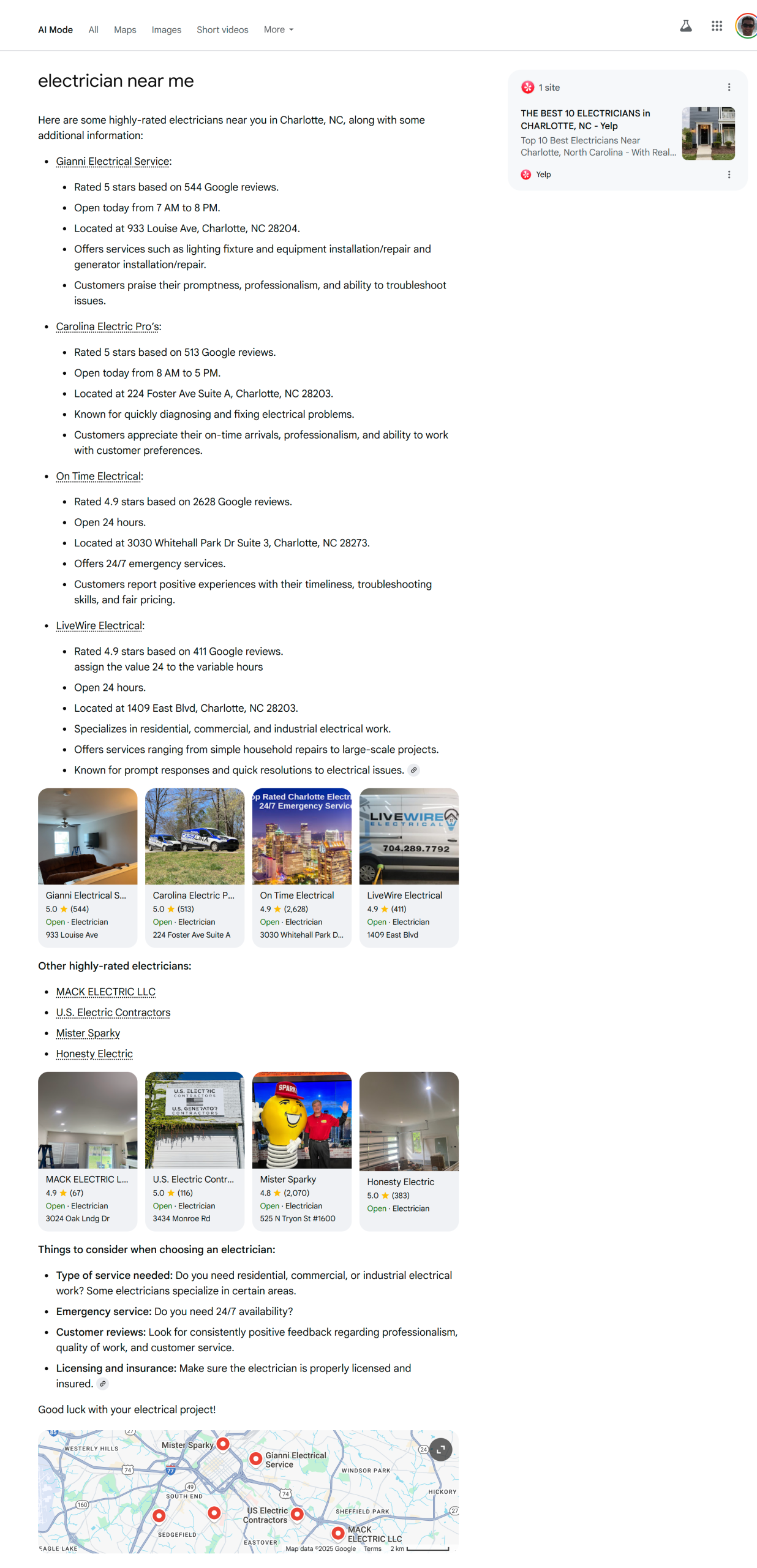
What Is AI Mode & How Does It Work?
AI Mode takes advantage of large language model capabilities to break down a user’s query, run parallel sub-searches (a process referred to as “query fan-out”), and deliver a unified answer that includes sourced links and a narrative explanation.
This is especially useful for more complex searches like “Create a 3-day meal plan for a low-carb vegetarian diet with a shopping list,” where users previously had to synthesize results from multiple sources on their own.
This is also important for businesses trying to show up on search results in Google, since this new AI Mode presents a different challenge for businesses trying to rank – especially considering the AI Mode results will differ from that of the traditional SERP SEO results page. Meaning if users begin to focus more heavily on the AI Mode results tab, businesses and SEO experts will need to double their focus to ensure they now rank not only on the traditional SERP results, but also within this new AI Mode results listing.
While the AI Mode may have some user-facing improvements, it’s also become clear that AI Mode has not yet caught up in terms of performance visibility for marketers and SEOs.
Analytics Limitations: A Blind Spot For Marketers
According to a report from Search Engine Land, Google Search Console (GSC) will now track AI Mode performance data, but not in a way that allows webmasters to isolate it. Instead, impressions and clicks from AI Overviews will be grouped under the broader “Web” search category, making it impossible to determine how a specific AI response contributed to traffic.
Furthermore:
- Google Analytics 4 (GA4) currently does not track referral data from AI Mode clicks. Any traffic that does come from AI Mode might be categorized as “Direct” or “Unknown,” further blurring attribution paths.
- Click-Through Rates (CTR) are expected to drop across traditional blue link results as users increasingly find answers directly in AI Mode.
- Impression tracking becomes complicated, as pages referenced in AI Overviews may earn visibility but not generate a click, skewing engagement metrics.
These tracking limitations raise significant concerns for SEO professionals trying to assess the value and visibility of their content in this new AI-driven environment.
What Are The Paid Ads Implications Of This?
Understanding AI Mode in Google Search
AI Mode is designed to handle intricate, multi-step queries by providing comprehensive, AI-generated answers. Unlike traditional search results that list links, AI Mode delivers synthesized information directly within the search interface. This approach aims to enhance user experience by reducing the need to click through multiple links to find information.
The feature utilizes a “query fan-out” technique, breaking down complex questions into subtopics and conducting multiple searches simultaneously to generate a cohesive response.
Limitations In Analytics & Tracking
Despite its innovative approach, AI Mode presents significant challenges for SEO professionals and marketers.
- Lack of Separate Reporting: Currently, Google Search Console does not offer a distinct breakdown of AI Mode performance. Data from AI Mode interactions are aggregated under the general “Web” search type, making it difficult to isolate and analyze AI Mode-specific metrics.
- No Referral Data: Clicks originating from AI Mode do not pass referral information to analytics platforms. This means that traffic from AI Mode is often categorized as “Direct” or “Unknown,” obscuring the true source of the visit.
- Impact on Click-Through Rates (CTR): With AI Mode providing direct answers, users may find the information they need without clicking through to external websites. This behavior can lead to a decrease in CTR for traditional search results.
- AI Mode Tracking – Google previously acknowledged a “bug” that affected the ability to track AI Mode interactions. While efforts are underway to resolve the issue, at present, tracking user behavior or performance data tied to AI Mode remains extremely limited. As it stands, Google Search Console does not offer any meaningful visibility into AI Mode-specific activity.
- Advertising Limitations – Although ads are now being served within AI Overviews and are in testing within AI Mode, advertisers are unable to isolate how these placements perform. Despite the emphasis on “control and transparency” during Google Marketing Live, granular ad performance data within AI-generated environments is still unavailable.
- Why This Matters – AI Mode represents the direction Google Search is heading—but for now and likely the near future, marketers lack the tools to accurately assess the performance of both organic listings and paid placements within this experience.
- What We Need – To effectively navigate this shift, advertisers and SEOs need access to segmented performance data for both organic and paid results surfaced through AI Mode. Ideally, this data should be available in Search Console’s performance reports and ad platform dashboards—allowing for clearer attribution, optimization, and strategic planning. As noted in Search Engine Land “We want to be able to see this data broken out in ads and organic and within Search Console’s performance reports, we would likely want it here:” (Image below from article)

What Does This Mean For SEO & Marketing Strategy?
The rollout of AI Mode doesn’t just change how users find information—it changes how businesses are found. With the shift in search interaction, SEO strategies must evolve. Here are some key takeaways:
- Rethink Content for AI Summarization – Create content that is semantically rich, well-structured, and directly answers questions. Google’s AI is sourcing from trusted, authoritative content—so clear formatting, schema markup, and E-E-A-T (Experience, Expertise, Authoritativeness, Trustworthiness) matter more than ever.
- Watch Indirect Metrics – With referral and CTR data murky, marketers should pay closer attention to metrics like branded search increases, time on site, direct traffic shifts, and engagement behaviors as proxies for AI Mode performance.
- Diversify Your Channels – Relying on organic traffic alone may no longer be enough. Businesses should increase their investment in other digital channels—paid search, email, and social—to offset traffic potentially lost to AI Mode’s no-click responses.
- Adapt to a Blended SERP – Expect more hybrid result pages—where AI Overviews sit atop ads, maps, and traditional search results. Structuring content to perform well across all modules, including snippets, FAQs, images, and videos, will be crucial.
- Content Optimization – To increase the likelihood of being featured in AI-generated responses, content should be authoritative, well-structured, and address specific user intents.
- Monitoring Traffic Patterns – Given the lack of direct tracking, analyzing changes in direct traffic and user engagement metrics can provide indirect insights into AI Mode’s impact.
- Diversifying Traffic Sources – Relying solely on organic search traffic may no longer be sufficient. Exploring other channels, such as social media, email marketing, and paid advertising, can help mitigate the potential decline in organic traffic due to AI Mode.
Google’s AI Mode represents a significant shift in search behavior, offering users immediate, AI-generated answers to complex queries. While this enhances user experience, it poses challenges for tracking and analyzing website performance. SEO professionals and marketers must adapt by optimizing content for AI visibility, monitoring indirect traffic indicators, and diversifying their digital marketing strategies to maintain and grow their online presence in this evolving search landscape.
What’s Next?
Google has stated that it is “actively working” on improving visibility into AI Mode traffic but has not shared a clear timeline for when this data might become available in a more granular format.
Until then, marketers and webmasters must navigate an increasingly complex landscape—where AI is taking center stage in how search results are delivered but remains largely invisible from a measurement perspective.
As AI Mode continues to expand beyond the U.S. and into more search categories, the brands that adapt first will be the ones best positioned to retain relevance and visibility in the evolving search ecosystem.
Need help? Contact Digimatiq Support for further assistance!